Female leadership – feedback from the pilot programme
In September 2025, Emmaus Europe launched a brand-new initiative: the first edition of the Women’s Leadership Programme.
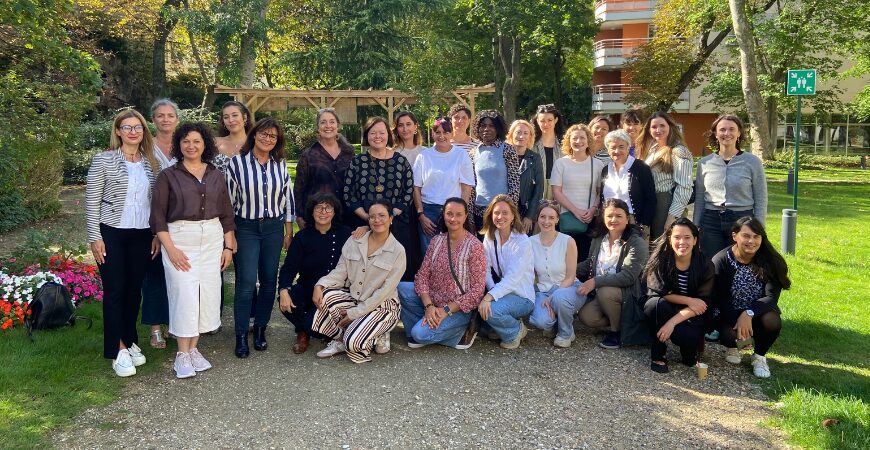
The programme brought together 23 women from the Emmaus Movement and from nine European countries for two days of intensive training in Paris on 11-12 September.
Emmaus Europe wanted to undertake a small-scale trial of this programme in order to explore how to foster more inclusive governance, and consequently strengthen the role played by women in our movement’s decision-making.
A training course focusing on female leadership
The course participants benefited from a multi-faceted programme focusing on the development of leadership skills. The course explored several areas, beginning with a look at the work of the Norwegian sociologist Berit Ås on domination techniques. Berit Ås identified seven mechanisms used to dominate in working environments: invisibility, ridicule, withholding information, double punishment, blame and shame, objectification, and threats of violence. These techniques are often subtle and unconscious. They particularly affect women in the workplace and hinder their working lives. We also reviewed the counter-strategies that can be implemented to reduce the impact of these techniques.
The programme enabled the key skills of female leaders in the Emmaus groups to be identified. Practical workshops enabled the participants to support their teams effectively and increase the impact of their communication.
A diversity of people with a shared need
The programme brought together a diverse group of women in positions of responsibility in their groups (on Boards or in teams). They all shared a common view, despite their different roles: they felt the need to undertake leadership training in order to feel completely at ease with their responsibilities and to continue developing their areas of expertise.
Leadership does not just boil down to holding a position of responsibility. People all too often conflate management and leadership. In fact, they are completely different roles. Leadership is more about an attitude and the ability to unlock potential, motivate and inspire your team or organisation to achieve a shared objective.
“I’m not afraid anymore”
An online catch-up meeting brought together the participants four months after the course. This catch-up session enabled learnings to be assessed and challenges encountered in the groups to be identified.
Since the course in September, all the participants have observed a change in their behaviour: self-confidence, peer trust, taking initiatives in their different groups to foster gender-neutral practices, etc. “The course enabled me to gain confidence in my skills and my stance with my teams, the volunteers and local partners”, said Lucie (France).
As part of its employment access and shelter and support work, the group works with a large number of women, both on the employment access scheme and Lucie’s two co-leaders. Lucie therefore wants to draw inspiration from the course dynamic so that her fellow workers also receive leadership training, and so that women-only spaces are developed. Her aim is to empower these women.
The programme also had a strong personal impact on all the participants. “I’m not afraid anymore”, said Karen (UK). “I feel more authentic. This has had a great impact on my relationships with the companions in my group.” Apart from the skills and knowledge acquired, the programme’s strength is bringing these women together as a group and enabling them to share experiences.
This takes the form of a tangible commitment in the Emmaus Movement’s governing bodies. Six of the 21 women who attended the September course are standing for election. They are looking to sit on various Boards: local groups, Emmaus Europe and Europe International. This desire stems from a collective realisation: the Emmaus Movement is much bigger than their own group. Everyone has their place in the movement and can make a contribution to help it move forward.
Towards more inclusive governance – the next steps
These first positive outcomes make us want to go further and create a snowball effect in the entire movement; and impact all the governing bodies, whether they are local, national or European.
A particularly encouraging initiative has already been put in place in the UK. Stephanie and Rebecca have launched a mentoring programme. At the same time, Stephanie contacted Emmaus UK to suggest arranging this type of course and involving all the new female leaders in a mentoring programme with more experienced female Emmaus leaders. Having received a positive reception from the Federation, she is now going to discuss the issue with the leaders of the UK groups with a view to rolling out the initiative nationwide. They are also considering a call for projects to support the initiatives run by female leaders of Emmaus groups.
We are therefore inviting the national organisations to take ownership of this dynamic, because it is the most effective way of restoring a balance of power. The issue goes well beyond that of the women currently in leadership and management roles. Training the groups on how to identify domination mechanisms, and deconstruct stereotypes and gender-based discrimination in particular, is just as important. Increasing the number of these sorts of courses, such as the female leadership course, will enable as many women as possible to benefit. This is how real change will happen at all levels of the movement.
Our movement has taken on board the issue of gender-based violence and is making great strides in this area. However, further progress is needed on the issue of gender equality in order to build the equal and supportive society called for by Emmaus.