Emmaus Europe

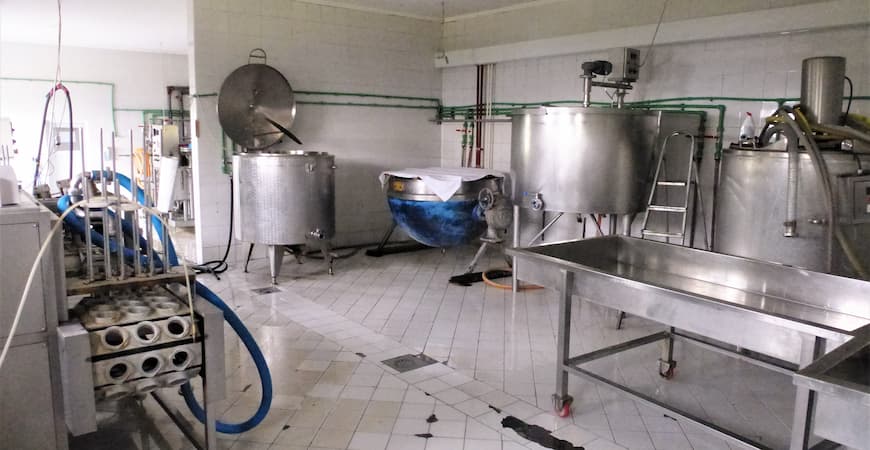
A creamery is helping refugees to rebuild

The IFS group was launched in Bosnia-Herzegovina in 1999 after members of the group met with Emmaus International during the war in the former Yugoslavia.

Today the wide range of activities launched by the group make it almost an alternative Ministry for Social Affairs: welcome for exiled persons taking the route through the Balkans, a retirement home for mothers of victims of the war, a centre providing psychological and geriatric care for the poor, social aid and food provided to isolated elderly people, grants for children of single-parent families in rural areas, etc.

In total the group serves over 3,000 meals a day to these people and this is why IFS decided to produce some of the food they consume themselves. They first launched their own bakery, allowing the group to make savings of 1,000 euros per month. Next, in the very rural Doboj region, the group decided to kill three birds with one stone by helping former inhabitants of the region to resettle there following the war. In the early 2000s these people had been provided with cows as part of the international resettlement programme but they had nowhere to sell the milk they were producing. IFS’ objective was, therefore, to collect this milk in order to provide income to these farmers and boost local employment. In turn, the creamery would produce the yoghurt, butter, milk and cheese that the group needs to provide food aid and maybe, one day, the creamery would be able to generate a small profit that would help the group to fund its many social initiatives.

The creamery was created in 2007 thanks to a partnership with the Italian Emmaus community of Villafranca. It currently employs 12 people and collects 2,000 litres of milk per day from small-scale local farms (1-10 cows per farm). In the first few years of its existence the creamery required external support in order to balance the budget but in the last two years the group has been able to generate a small profit at this site by selling some of its produce to shops and restaurants. They now have plans for an extension!
Bosnia Herzegovina Defending human rights / Migration  News

Velüs: bikes just keep on giving

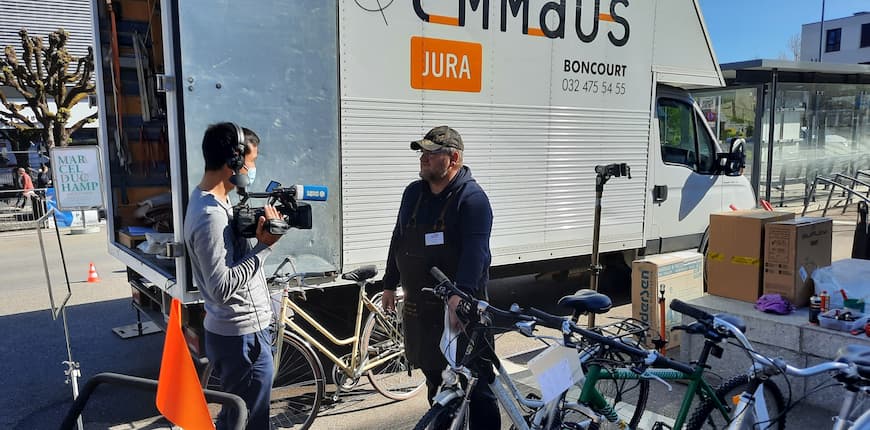
Cycling is, after walking, the most environmentally-friendly mode of transport. Bicycles are also the best vehicle in terms of social value and in terms of contributing to the creation of a fairer economy. Basically, the Velüs project is a no-brainer! This Emmaus project involves cleaning and repairing second-hand bikes as well as managing the bikes according to a circular economy logic: by re-using bikes that have been given to Emmaus. Vincent Chapuis, the leader of the Emmaus Jura group, told us a little bit about this trendy project being led by Emmaus in Switzerland.

Emmaus Jura decided to use bikes as a means for creating a fairer, more equal society. Thanks to partnerships with associations which work in the field of mobility and who are our allies in the social economy sector, we were able to open a repair/upcycling workshop in Boncourt. Michel joined us and has since become “Mr Velüs”. He set up the workshop and skilfully oversees the repairing of the bikes, some of which are sent to us in poor condition. This activity has not yet reached financial autonomy but it provides us with a great opportunity to reach out to a new audience and to tell them about what Emmaus does. For example, the Velüs team sometimes leave the workshop for events where we offer free repairs and maintenance. At these events people (re)discover that bikes, even old bikes, are both useful as a way of getting around and as a way of forming bonds with others.

A brand to develop and a network to create

In the Jura region, hidden away in garages and attics, an estimated 2,000-3,000 bikes are waiting to hit the roads again! We decided to work with just mechanical bikes, not electric bikes, and we have partnerships with independent bike shops from our local area. The local salesmen have outlined how what Velüs brings to the table complements their offer. Our intention now is to continue to build up the Velüs brand (a word combining “velo” (bike) and “Emmaus”) in order to make the most of the social potential that bikes offer. We are looking for partners to help us to create a network of skills throughout the Emmaus movement as many of our groups regularly fix bikes. Together we could share our technical knowledge and also contribute towards developing more social and income-generating initiatives related to bikes and cycling. What do you think of the idea of an Emmaus bike network that stretches all across Europe?

More information on https://emmaus-jura.ch

Circular economy / The environment  News Switzerland

© Emmaus Jura

Emmaus in Poland

A discussion with Grzegorz Hajduk, national delegate for Poland on the board of Emmaus Europe.

Can you tell us about how Emmaus began in Poland?

It all started when the founders of the communities of Lublin and Nowy Sącz got in touch with representatives of Emmaus International and thanks to the support of the French communities and the Emmaus community in Cologne. Emmaus Lublin was founded in 1995. In 1999, a community was established in Nowy Sącz, which in 2003 founded a new community in Kraków – Nowa Huta. One association, Emmaus Brat Albert, now runs these two sites.

Emmaus Brat Albert started to follow the spirit of Emmaus in 1999. With the help of many communities from all across Europe, we have made a huge extension and modernised the building in which the Emmaus community was “born”. We also built a house and a farm in Krakow. Nowadays we are working together to achieve more dignified and honest lives, to build a fairer society and to help those who experience poverty and exclusion.

Another community was founded in 2007 in Rzeszów. After financial problems related to the construction of a new house in recent years, this project is now moving forward thanks to the help of our Emmaus friends.

What activities are led by Emmaus in Poland?

Communities in Poland focus on collecting and selling second-hand goods, Emmaus’ traditional activities. We also offer carpentry workshops to our clients and have vegetable gardens which people can use. In Lublin an Italian-Turkish restaurant is managed by the community and can seat up to 75 customers. During the lockdown, this was of course no longer possible, but they adapted to the situation by offering a take-out service. They also run an urban furniture project in collaboration with the local authorities.

All the communities have been created by companions who used to be homeless. Today, there are 16 companions in Rzeszow, 34 in Brat Albert and 20-30 in Lublin. Overall, there are around 100-120 people involved in Emmaus in Poland (companions, volunteers, employees, etc). In addition to our communities we also run homeless shelters, notably in Brat Albert.

How have things been going since the health crisis and how did you adapt to the situation?

We thought it was going to get worse but because of the administrative chaos and conflicting guidelines we were able to carry on selling in our stores. Some of our groups also developed online stores which provided another option to maintain our activities. The pandemic bypassed the communities really – now all members of the communities are vaccinated and we are more optimistic about the future!

What are the challenges facing groups in your country (now and before the crisis)?

The biggest challenge is to maintain our communities and sustain the cooperation between them. The pandemic severely limited direct contact between the members of the groups but we tried to meet as often as possible. We are not very rich communities, sometimes we have problems maintaining our financial liquidity and we are constantly working on this to ensure the brightest possible future for the members of our communities.

Could you add some words about the political situation of the country?

The political situation in our country is not very stable, the right-wing populists that have been in power for 6 years have led us to the highest level of inflation in 30 years, there are deadlocks regarding domestic and foreign policy whilst corruption and nepotism are flourishing. But because they put money in the right pockets they still enjoy great popularity and it is difficult to predict the result of the next election. The influence of the Catholic Church on power and legislation is increasing, especially concerning moral matters and education. Nationalist and xenophobic ideas have been stirred up and a campaign against LGBT people has been launched. Chaotic changes to the law threaten us with exclusion from the European Union, our membership in NATO becomes more fictitious by the day and there are several signs that our country is being pushed into the arms of Russia…

News Poland

© Emmaus Krakow

#AbolishFrontex

A campaign to abolish the European Border and Coast Guard Agency and end the EU border regime.

Over 740 people have died so far this year trying to cross the Mediterranean, looking for a place of safety. The EU’s border regime forced them to take dangerous migration routes, often on unseaworthy vessels; it enlisted neighbouring countries to stop them on their way; met them with violence and pushbacks; or refused to rescue them – abandoning them to drown at sea.

Frontex is the European Border and Coast Guard Agency that lies at the centre of this violence. Often hiding away from public scrutiny, over the past months a series of investigations by journalists and human rights groups have put Frontex in the spotlight. Extensive evidence has exposed how the EU’s border force is repeatedly involved in pushbacks and human rights violations.

As a member of Migreurop, Emmaus Europe support the #AbolishFrontex campaign, which claims:

  • Abolish Frontex
  • Regularise migrants
  • Stop all deportations
  • End detention
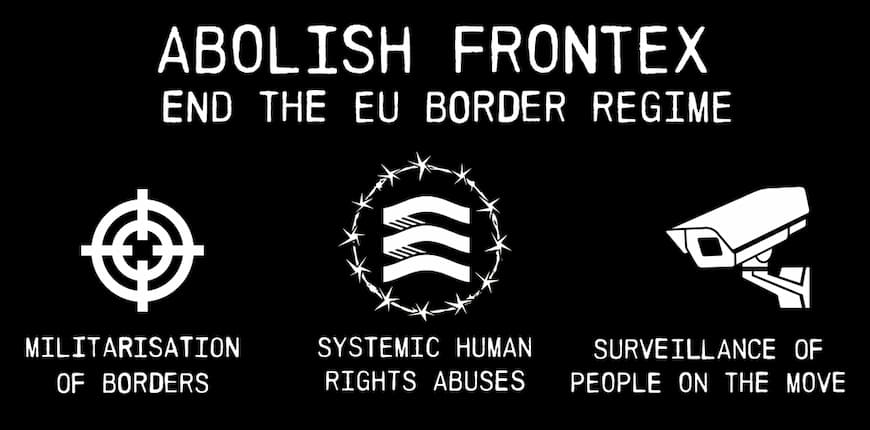
  • Stop the militarisation of borders (and the military industrial complex)
  • Stop the surveillance of people on the move
  • Empower solidarity
  • Stop the EU’s role in forcing people to move
  • Freedom of movement for all
  • End the EU border regime

For more information about this international campaign/to get involved: abolishfrontex.org

Defending human rights / Migration  European Union News