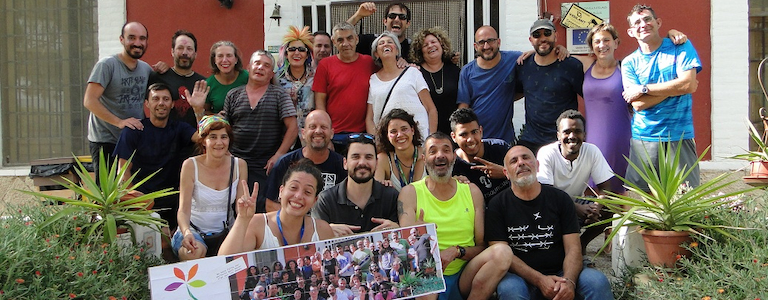
A discussion with José María García Bresó, national delegate for Spain on the board of Emmaus Europe.
Can you tell us how Emmaus began in Spain?
The first Emmaus initiatives in Spain were launched in 1969 with the first young volunteers camp in Vizcaya. The event came to be thanks to discussions with the Union of Emmaus Friends and Companions (UACE) and thanks to Abbé Pierre/Emmaus’ ideology of helping the most vulnerable and showing solidarity. Following on from this initiative we held several camp events which spread the word throughout the country about Emmaus’ initiatives and principles. In 1972 the “Emmaus in Spain” association was created, representing two local groups, one in Bilbao and the other in Pamplona. We also had a friends’ committee and several young volunteers at the time. The movement became stronger in Spain when the groups became full Emmaus communities (Bilbao became a community in 1976 and Pamplona in 1978). We continued to organise the youth camps and these events led to the creation of other Emmaus communities (Torrelavega, Sabadell, Rentería and Murcia) which continued to widen the scope of their action and to change their activities. Now, we have 5 full member groups, 2 trial member groups and 1 group which is currently an observer and which has asked to become a trial member.
What initiatives does Emmaus lead in Spain?
In Spain the groups have developed various activities over the years, depending on the local context and the local needs. All of the groups do the traditional work of collecting large items, paper/cardboard, glass, clothing and electronic waste and preparing it for reuse or for recycling. Some of the Spanish groups have come to agreements with the authorities (following competitive public calls for projects) to carry out waste collection and processing work.
Since 1981 Emmaus in Spain has been a pioneer in launching selective waste collection systems. We defend our methods, which help us to create work, and we campaign for waste collection to stay in the hands of social economy organisations which have a long history of social struggles and environmental activism.
We continue to defend and apply our “waste hierarchy” system and to strengthen our Centres of Preparation for Reuse.
Some of the groups also lead prevention and awareness raising initiatives on environmental matters and they do so on their own or in collaboration with the authorities or with social/environmental networks.
Furthermore, some of the Spanish groups lead sustainable farming and mobility initiatives whilst all of our groups try to mobilise and raise awareness for social change, for more solidarity and in support of the most excluded (care for the homeless and for those living in shanty towns, internationalism, etc.).
How have things been going since the health crisis first broke out and how have you adapted to the situation?
All of the groups have had it tough. The majority have had to stop their income-generating activities at some point or another whilst uncertainty and insecurity due to the constant changes to the rules have been the norm of late. All the groups have had to deal with the sadness, frustration and isolation that the various lockdowns have caused.
All of our groups, to varying extents, have had to turn to the government’s temporary workforce adjustment plan, helping to ensure that none of our members have been left without income. We have started to help ourselves more, focusing on the safety both of the individual and of the collective in the workplace, with the use of hand gel, masks, hand washing, social distancing, etc..
We have been trying to get on with life, continuing with our struggles and learning to adapt and to live under the “new normal”.
What challenges are the Spanish groups currently facing?
We are facing plenty of challenges, like most people at the moment, but during this crisis period we are focusing on strengthening our work and generating the resources required to remain self-sufficient and to be able to offer solidarity to others, thus ensuring that we stay true to our values.
On the topic of self-sufficiency we are looking for new ways to sell our items and for new infrastructure in order to meet the challenges we are facing. In doing so we will continue, however, to stick to the principles that guide us, as outlined in Emmaus Spain internal document on our common identity.
Given that we are not alone and that many other people and groups are having to fight against the successive crises we have witnessed recently, we are looking to be more involved in solidarity networks, partnerships and alliances. We still want to be at the forefront, however, by outlining that our values, solidarity and social/political struggles are the right approach.